

Men enroll in self-defense courses for many reasons: a scare on the street, a new job with late shifts, or a sense that “being ready” is part of adulthood. Yet some treat training like entertainment—checking crazy time live game online between drills—then expect the same instant payoff from a weekend class. Real violence does not work that way.
The useful question is not “Which style wins?” but “Which course elements change outcomes under stress, in limited time, with legal and medical risk?” The answer is less about secret techniques and more about decision-making, practice design, and what the program rewards in students.
What self-defense training must prepare for
Most assaults are short, close, and chaotic. They start before the first punch: targeting, approach, verbal probing, boundary violations, and sudden grabs. Many courses focus on the “fight” phase because it is easy to film and sell, but prevention and exit drive results.
Situational awareness is the base layer: noticing what is happening around you and whether there may be a threat, early enough to change position or leave. That “early enough” is the point. A course that treats awareness as a slogan, not a trained habit, is skipping the part that prevents most physical contact.
A second constraint is law. Self-defense is not “anything goes.” Many legal systems hinge on necessity and proportionality: force that may be justified while a threat is active may become unlawful once the threat ends. Details vary by jurisdiction, including questions like whether there is a duty to retreat outside the home or “stand your ground” rules. Any serious course should address local basics and encourage students to learn the rules where they live.
What tends to work in men’s self-defense courses
1) Avoidance and movement, trained as decisions
Good programs teach “leave early” skills: scanning entrances, keeping distance, using barriers, and choosing routes. They also teach exits as a default, not a failure. This is where conflict management and communication fit: clear boundary-setting, de-escalation attempts, and a plan to disengage. Public safety guidance often frames situational awareness as a decision tool, not just observation.
2) Verbal skills with physical positioning
Verbal de-escalation is not magic, but it buys time and space when it works. In practice, the key is pairing words with body placement: hands up in a non-threatening posture, angle off the centerline, keep distance, and keep an exit behind you. If a course teaches “talk them down” without the movement that supports it, it is incomplete.
3) Simple, high-percentage physical skills
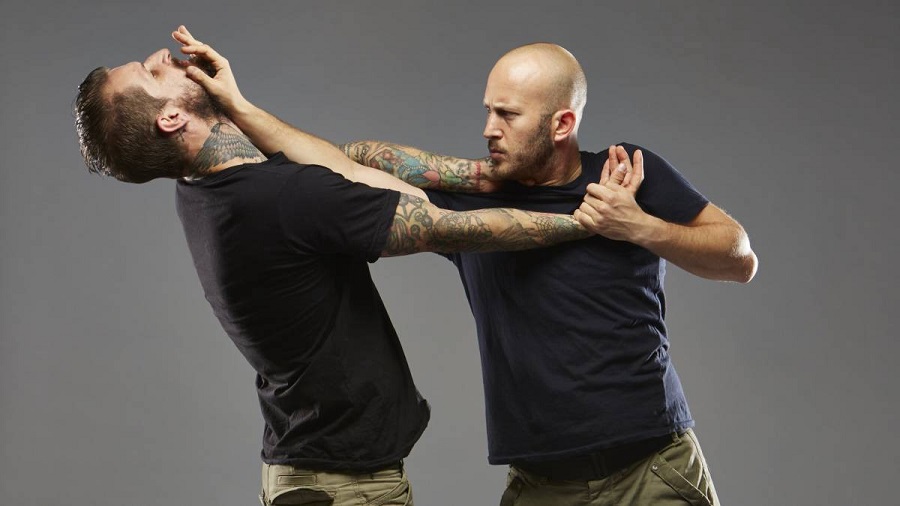
Under stress, fine motor sequences degrade. Courses that emphasize a small set of gross-motor actions tend to transfer better: breaking grips, framing with forearms, creating space, and moving to an exit. Striking can help, but the goal is often to disrupt long enough to leave, not to “win a fight.” The same logic applies to grappling ranges: learning to stand up from the ground while protecting the head is more realistic than learning to “finish” someone.
4) Resistance and pressure testing, scaled to the student
Technique without resistance is choreography. What matters is whether students practice against a partner who is trying to stop them—safely, with rules and protective gear. Resistance reveals timing problems, balance issues, and the gap between “I know the move” and “I can do it.”
Pressure testing does not need to be reckless. It can start with mild resistance and build toward controlled sparring or clinch work. The indicator is whether students routinely fail in training and then adapt. If everyone always “wins” in class, the training is not measuring reality.
5) Scenario training that includes pre-contact cues
Scenario work is where awareness, verbal skills, and physical exits meet. Done well, it trains recognition (the approach), decision points (leave, comply, escalate), and the post-event phase (call for help, report, medical checks). Scenario training should be structured, brief, and reviewed. It should not be a surprise assault that overwhelms beginners for drama.
6) A fitness baseline and injury prevention
Men often assume size solves problems. It helps in some contexts, but fatigue and injury erase advantages fast. Courses that include basic conditioning (cardio intervals, grip, core stability) and safe falling reduce risk during training and raise the odds of executing escapes.
7) Psychological benefits—when tied to practice
Research on self-defense and combat-sport training often finds gains in confidence, stress handling, or perceived resilience, though effects depend on program design and population. Confidence is useful when it supports early exit decisions; it is harmful when it fuels escalation.
What is mostly myth
Myth 1: “One move ends it.”
Any claim that a single technique reliably stops an attacker ignores variation: size, surprise, multiple attackers, surfaces, and adrenaline. Realistic training builds layers (awareness → distance → exit), not a single “finisher.”
Myth 2: “Pain compliance always works.”
Pressure points and small-joint tricks can fail under intoxication, high arousal, or poor positioning. If a course centers its curriculum on pain responses, it is betting on a narrow mechanism.
Myth 3: “Weapon disarms are a plan.”
Knife and gun defenses are high-risk. Training may include last-resort options, but selling disarms as a primary strategy is misleading. A better program frames weapons as an avoidance problem first: distance, barriers, escape routes, and compliance when it increases survival odds.
Myth 4: “Street-only techniques beat trained fighters.”
Marketing sometimes suggests that “dirty” moves replace training time. In practice, people still need position, balance, and timing to use anything. If a school mocks sparring and never trains against resistance, it is not “street,” it is untested.
Myth 5: “A certificate equals capability.”
Short courses can be valuable, but skill is perishable. If the business model is “learn it once,” expect fast decay. A solid course is an entry point into ongoing practice.
How to choose a course with less guesswork
Use these criteria as a filter:
- Curriculum balance: Does it spend meaningful time on awareness, verbal skills, and exit tactics, not just strikes?
- Training method: Is there progressive resistance, or only compliant drills?
- Safety and structure: Clear rules, protective gear, and controlled intensity.
- Instructor clarity: Can the instructor explain what the technique is for, when it fails, and how it fits a legal framework of necessity and proportionality?
- After-action content: Basic first aid priorities, calling authorities, and documentation habits.
A useful sign is modesty: instructors who stress uncertainty, encourage escape, and avoid promises tend to teach systems that survive contact with reality.
Bottom line
What “works” in men’s self-defense courses is rarely mysterious: awareness trained as a habit, communication paired with positioning, a small set of escape-focused physical skills, and practice against resistance under safe constraints. What is myth is the sales layer: instant mastery, guaranteed disarms, pain-based shortcuts, and certificate-as-skill. The best course is the one that changes what happens before violence, and still functions when prevention fails.
